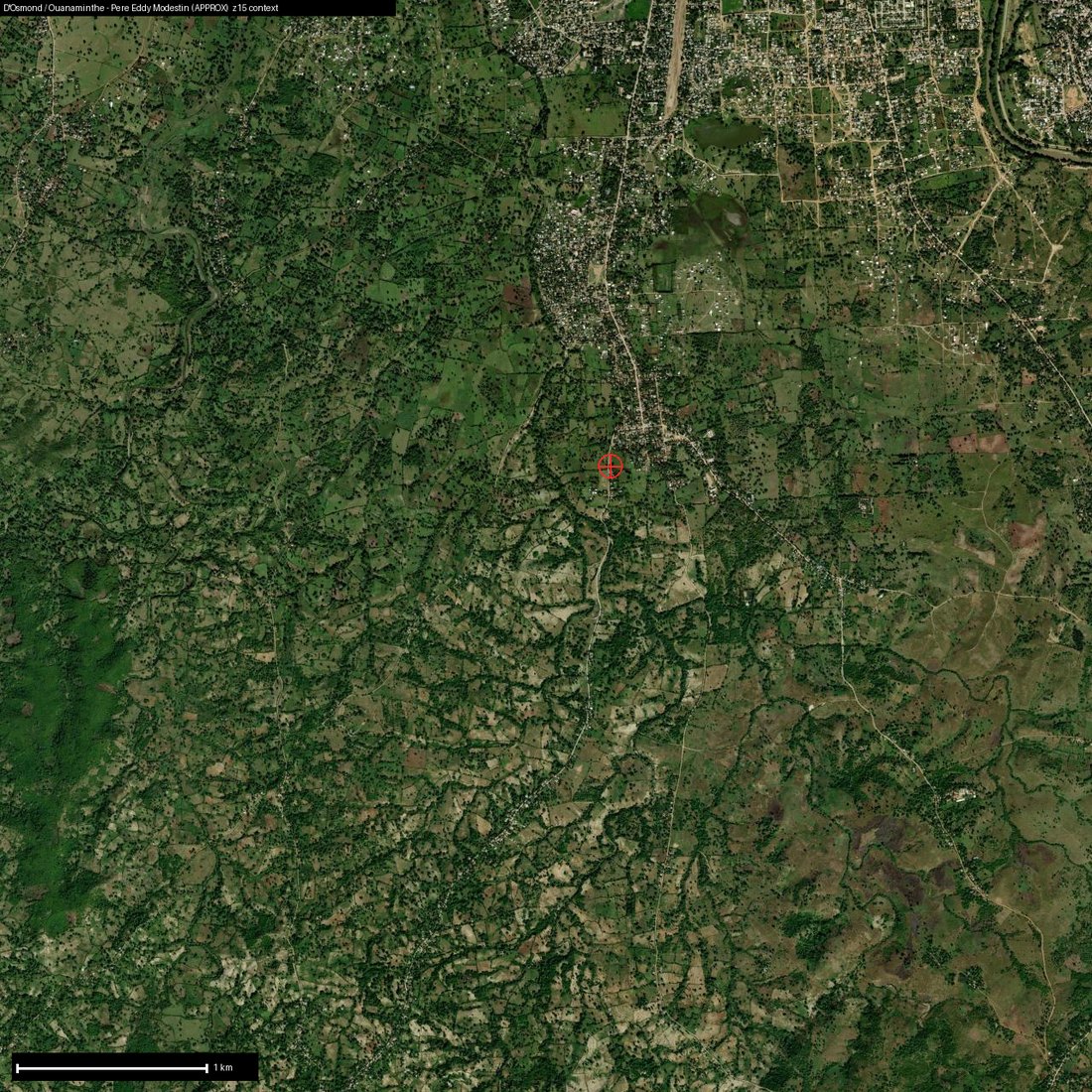
The flattest, sweetest soil in the set... near-neutral clay loam you plant straight into, no lime. The catch is water: a semi-arid plain that lives or dies on the stream to the west. A clean cassava site once the parcel confirms.
The best raw growing ground we surveyed: flat at 2.2°, near-neutral clay loam at pH 6.4 that needs no lime, with healthy topsoil (SOC 3.2%, CEC 22). It sits about 19 m above the nearest drainage, so flooding is unlikely and erosion is modest at 7.5 t/ha. The one binding constraint is rain... 744 mm/yr on the semi-arid Ouanaminthe plain, with a hard December-to-March dry season. The stream ~730 m to the west is the whole game.
Moringa, castor and pigeon pea all grade a perfect 1.0; cassava follows at 0.95, docked only by the dry season. A deep dry-lowland bench... cassava to flour to the Harvest Box as the anchor, with moringa, pigeon pea and peanut widening the field.
Same cassava-flour economics as the Nord sites: the grower gets about $0.24 of root value in a pound of flour that finishes as an $18.75 branded product, and SAKALA keeps the milling and the margin inside the cooperative.
Numbers are provisional until the parcel confirms. The $6,500 runs it as a cassava atom (kit, cuttings, cover crop, wages). The optimized $18,000 adds the dry-season answer... a pump, cistern and drip off the west stream. The jump to the dream figure is a shared cassava processing line, the value-capture step.
0 young people work here today, room for 10. A six-month renewable apprenticeship at $52/month base plus a surplus share, and a 40%-rising-to-51% ownership stake in the cooperative. Binding constraint: Dan to confirm the exact parcel and acreage; the west stream is the dry-season lifeline.
Nothing here is funded until Dan confirms the parcel, the flood fringe, and the quarry next door. Check back, or sponsor one of the live TapTaps in the meantime.
Gated · verifying with Dan